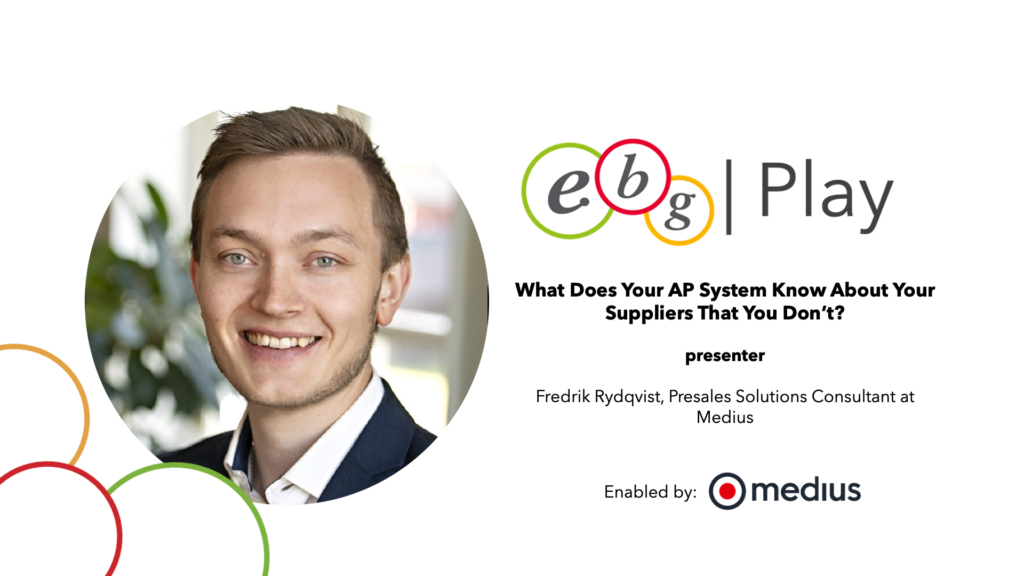
Webinar recap: Fredrik Rydqvist from Medius on why the invoice might be the most underused data source in procurement
The starting point: one step no supplier ever skips
Every step in the source-to-pay process can be bypassed. Requisitions get skipped. POs forgotten. Contracts ignored. Receipts go missing.
But there’s one step no supplier ever skips: sending an invoice.
“Suppliers will always want to get paid,” said Fredrik Rydqvist, Presales Solution Consultant at Medius, during our March 3rd webinar. “That’s why the invoice becomes the system of record for what truly happened.”
This simple observation – that AP data captures reality, not intention – formed the foundation for a 45-minute exploration of what procurement might be missing by not looking closer at accounts payable.
We asked participants: when preparing for a supplier negotiation or contract renewal, where does your team typically source performance data?
The results revealed what Fredrik had anticipated – a mix of sources, with no single dominant approach. Internal stakeholder feedback and manual tracking came out on top, followed by reports from finance and AP, external sources like credit ratings and risk tools, and dedicated SRM platforms. Very few rely primarily on the supplier’s own reporting.
“It’s interesting that it is this kind of mix,” Fredrik noted. “A lot of you are relying on AP data already today. Hopefully we can expand upon what kind of data you can actually get from that perspective.”
The fact that manual tracking ranked highest suggests there’s room to make existing data more accessible – data that’s already being captured, every day, with every invoice.
Same suppliers, different language
One of the more striking slides showed the semantic gap between AP and procurement:
| Accounts Payable says | Procurement says | What it actually represents |
|---|---|---|
| PO Invoice | Order-based purchase | Supplier invoicing against an approved PO |
| Non-PO Invoice | Indirect / Tail spend | Purchases without a PO – spot buys, maverick spend |
| Invoice deviation | Purchase price variance (PPV) | Difference between contracted and invoiced price |
| Invoice line mismatch | Supplier performance issue | Differences in quantity, UoM, delivery timing |
| Late invoice / Missing PO | Process non-compliance | Breaks in the S2P chain |
“We might be talking about the same thing, but from our own viewpoints,” Fredrik explained. “If we don’t bridge that point of view, we’re missing the fact that we can actually help each other.”
The invoice line, he argued, is the shared source of truth. Both functions look at it – from opposite ends.
AP-first spend management: what does it mean?
Fredrik introduced Medius’s concept of “AP-first spend management” – not as a product pitch, but as an approach to thinking about data.
“AP-first doesn’t mean we only care about accounts payable,” he clarified. “It means we see the invoice as the starting point for pinpointing what micro-surgeries you should start with to fix your source-to-pay process.”
The traditional S2P process assumes perfect compliance: right requesters, right catalogs, right POs, right receipts. Valuable, but fragile.
AP-first means starting from what actually arrived – the invoice – and reconciling back to POs, contracts, and receipts. Surface variances. Drive targeted improvements. Category by category, supplier by supplier.
“The goal isn’t to stop the business,” Fredrik said. “It’s to observe real buying behavior, understand the patterns, then optimize.”
View the On demand webinar
Click the image or the >>this link to view the On Demand webinar.

The AI demonstration: from raw data to contract clauses
The most concrete part of the session was Fredrik’s demonstration of what becomes possible when you connect structured AP data to an LLM.
He took a standard deviation report from Medius – raw data showing mismatches between purchase orders, goods receipts, and invoices. Price variances, quantity deviations, supplier by supplier. No pre-analysis.
Using Microsoft Copilot, he asked a simple question: analyze this data set for patterns related to specific suppliers.
Within minutes:
- An overview of which deviation types were most common
- Graphs showing deviation amounts by supplier
- Recommended next steps per supplier
- And when asked about an upcoming contract renegotiation with “Blue Steel”: suggested contract clauses based on actual deviation patterns
“This altogether took me a little over two minutes,” Fredrik noted. “I was actually a bit surprised in terms of how effective this was and how accurate the results were.”
He was careful to add context: “Obviously, if I’m going to use this, it needs checking for accuracy. But what I get here is a great starting point to understand where to dig deeper.”
Does this make pre-built dashboards obsolete?
Fredrik’s answer: no.
“We do provide a lot of ready-made analytics dashboards ourselves,” he said. “But these pre-built dashboards take time to develop and maintain. They tend to be static. We’re probably missing some interesting facts that we could use AI to actually get insights into – without first having to spend two weeks building the perfect report.”
The point isn’t to replace existing tools. It’s to complement them – to be more agile for edge cases, for questions that arise between the formal reviews.
The evolution of procurement roles
Fredrik referenced findings from EY presented at Medius’s customer conference: the procurement professional’s role has changed dramatically.
“Just a couple of years ago, someone working in procurement could have this traditional persona with strong business acumen and market knowledge,” he said. “But with digitalization, COVID impacting how we navigate risk, disrupted supply chains – we’re looking into a future where a procurement professional really needs to act more as a data-driven supply chain engineer.”
The expectation: do more complex tasks, but not necessarily with more resources. What’s changing is the tools available.
“Data is king – can finally be realized,” one of his slides stated. The premise being: we’ve talked about data being king since we started digitizing processes. But that was built on having the time, tools, and skillset to analyze it. That’s where it fell apart.
Now, with LLMs able to process large data sets and answer questions in plain language, the equation changes.
Key takeaway: have you talked to your AP team?
When asked what participants should take away, Fredrik’s answer was practical:
“How deeply do you actually talk with your accounts payable team? Have you investigated the opportunities for getting data from that angle? Is there information that could be extremely valuable for you in your daily life that you’re simply not accessing – because you haven’t made that bridge to the AP team?”
The data is there. It’s captured with every invoice. The question is whether anyone’s asking it questions.
What we discussed
- Why AP data might be the most complete picture of supplier performance
- The semantic gap between how AP and procurement describe the same reality
- What “AP-first spend management” means in practice
- How AI/LLMs can make raw deviation data accessible in minutes
- Why the invoice is the single source of truth: suppliers always want to get paid
About Medius
Medius links invoice capture, processing and payment to replace the worry and wondering of managing AP with calm and confidence. Medius goes far beyond basic automation by using artificial intelligence to do most of the work – so invoices get confirmed, coded and paid and businesses can trust their budgets and forecasts. Medius, on a mission to transform the spend management
Continue the conversation
This webinar was part of EBG Network’s ongoing exploration of how procurement and finance can work more closely together – and how technology is changing what’s possible.
Upcoming events:
- EBG | Xperience Stockholm – April 23rd
- EBG | Xperience Malmö – April 28th
- CPO Outlook 2026 – October 14-15, Stockholm
Recording and slides have been sent to all registered participants.