• EBG | Summit
    • CPO Outlook
    • CPO Outlook 2024 | Post Summit Page
    • CPO Outlook 2023 | Post Summit Page
    • CPO Outlook 2022 | Post Summit Page
  • EBG | Webinar
  • EBG | Play
  • EBG | Xperience 2026
    • EBG | Xperience 2025
      • EBG | Xperience STHLM 2025
      • EBG | Xperience GBG 2025
      • EBG | Xperience CPH 2025
    • EBG | Xperience Terms & Conditions
  • About EBG | Network
    • Contact EBG | Network
    • Networking with EBG | Network
    • Privacy Policy

EBG | Network | Nordic Procurement Insights & Events

Procurement knowledge sharing through roundtables, workshops and events

The Human Side of Digital Evolution: Why Our Brains — and Our Companies — Struggle to Keep Up

October 10, 2025 By ebgnetwork

Spread the word

The Human Side of Digital Evolution: Why Our Brains — and Our Companies — Struggle to Keep Up

When we talk about transformation, we tend to think in systems: technology stacks, processes, AI platforms, and operating models.
But beneath it all, there is one constant — the human brain.

It has powered every revolution since the Industrial Age, yet remains largely the same.
And perhaps that’s the most important insight of all.

A note from experience

EBG | Network was founded on behavioral-science research Anna Bjärkerud conducted at Stockholm University — exploring how people’s sense of self is shaped by what they do.

The candidate’s thesis focused on “How is professional identity affected by planned organizational change?”.

In her study of service engineers at Sveriges Radio, she found that when organizations change structures or goals, they also — often unknowingly — change people’s identities.

When work shifts from something deeply meaningful (“we make radio”) to a more abstract role (“we provide service”), the response is rarely resistance to progress — it’s resistance to losing a part of oneself.

That insight still holds true today. As AI, automation, and new technologies redefine work, the real transformation challenge isn’t digital — it’s human. People understand who they are by what they do. If we want organizations to evolve, we must help individuals rebuild that connection between doing and being.


1. The Human Brain Hasn’t Changed — The World Has

From a biological perspective, our brains today are almost identical to those of people in the 1800s. Evolutionary change takes tens of thousands of years, while industrialization and digitalization unfolded in just a few centuries (Lieberman, 2013; Doidge, 2007).

Our neocortex gives us reasoning and abstraction — but it sits on top of an older architecture optimized for survival: short-term focus, pattern recognition, and emotional response. This design helped our ancestors survive scarcity and danger, but it also explains why modern humans:

  • Struggle with information overload.
  • Seek simplification and routine when overwhelmed.
  • React emotionally to uncertainty and change.

Cognitive science calls this a “mismatch problem” — ancient instincts in a world of exponential complexity (Tooby & Cosmides, 1992).


2. Our Cognitive Limits — Why Overload Triggers Silos

Psychologist George Miller found that the average person can hold about 7±2 pieces of new information in working memory (Miller, 1956). More recent studies put that number closer to 4±1 meaningful chunks (Cowan, 2010).

When faced with too much novelty, the brain reduces stress by:

  • Filtering (ignoring signals that seem irrelevant),
  • Chunking (grouping concepts into categories), and
  • Relying on habit (using existing “scripts” instead of new reasoning).

This same pattern is visible in organizations.
When complexity grows, companies revert to silos. Departments narrow their focus, protect their domains, and double down on control. It’s the corporate version of a neurological defense mechanism.


3. The Organizational Brain — Built for Control, Not Coherence

Just like neurons, teams and departments specialize. They form internal “circuits” (finance, procurement, IT, operations), optimized for efficiency rather than integration.
This worked well in the industrial and early digital eras — when problems were linear, predictable, and slow.

But AI, sustainability, and geopolitical risk are interdependent challenges. They require cross-functional pattern recognition, context-sharing, and fast learning — traits our traditional organizational “wiring” wasn’t built for.

In other words: we designed companies for control, not cognition.


4. The Attention Bottleneck — Our True Limiting Factor

Modern humans consume more information in a single day than someone in the 1800s did in a lifetime (Hilbert & López, 2011).
Yet comprehension hasn’t scaled.
Studies show that information overload decreases decision quality and increases reliance on heuristics — mental shortcuts and biases (Kahneman, 2011).

The result:

  • Endless dashboards but little shared understanding.
  • Faster reporting but slower sense-making.
  • More meetings, less meaning.

The limiting factor of digital transformation isn’t data or AI — it’s human attention.
Until we protect and expand that capacity, new technology only adds noise.


5. How Leaders Can Bridge the Gap

  1. Design for cognitive reality
    Simplify language, harmonize interfaces, visualize complexity. Every unnecessary click or acronym burns mental energy.
  2. Build shared sense-making loops
    Create time for teams to reflect across functions — not just execute. Thinking together is strategic work.
  3. Reward integration, not activity
    KPIs should measure coherence, not throughput.
  4. Protect focus time
    Deep work and recovery are the new corporate resources.
  5. Use AI to amplify meaning, not replace thought
    The goal isn’t to offload judgment — it’s to extend human reasoning.

6. The Future: Aligning Brains, Systems, and Purpose

Our tools evolve exponentially.
Our brains evolve linearly.
The challenge of our era — and the opportunity — is to align the two.

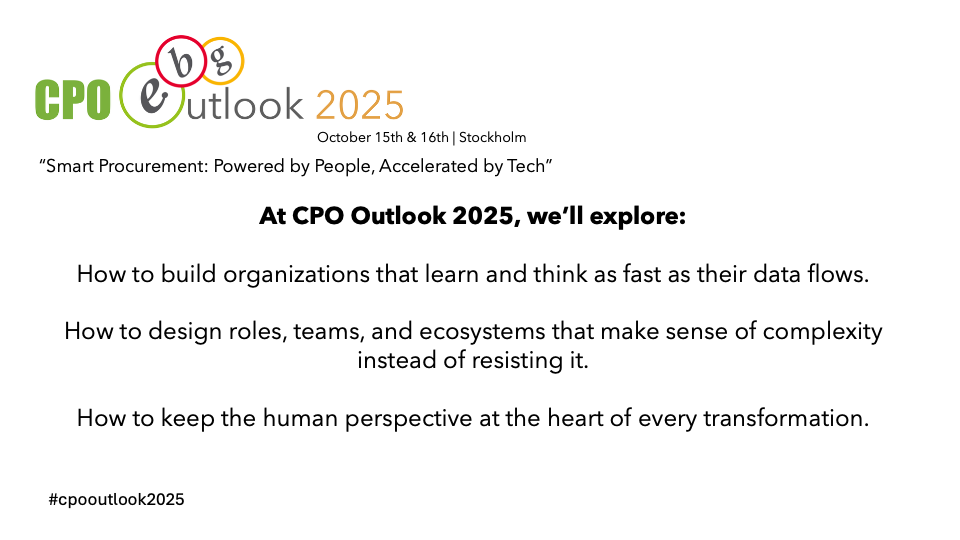
At CPO Outlook 2025, we’ll explore what this means for procurement and business leadership:

  • How to build organizations that learn and think as fast as their data flows.
  • How to design roles, teams, and ecosystems that make sense of complexity instead of resisting it.
  • How to keep the human perspective at the heart of every transformation.

Because in the end — we’ve built systems that move at the speed of light, but we still think at the speed of the human mind.


Spread the word

About EBG | Network

EBG | Network enables real conversations between Nordic decision-makers in procurement, sustainability, and business development. Since 2010, we’ve created independent forums for experience exchange — exploring how human responsibility, processes, and technology intersect in practice.

EBG focuses on quality over quantity, dialogue over noise — creating spaces where senior professionals exchange real experiences and shape ideas that last beyond an event.

EBG is managed by Anna & Lars – partners in business and life. Contact us today with any type (business) related questions!

anna(at)ebgnetwork.com & lars(at)ebgnetwork.com

CPO Outlook 2025 | Post Summit Page (for attendees)

Protected: CPO Outlook 2025 | Post Summit Page

Sign up to learn more about EBG | Xperience in MALMÖ, HELSINKI & STHLM 2026

EBG | Xperience 2026 – Planning Overview

Find what you are looking for

Never miss out on EBG content!


Required
Invalid e-mail addre
Max 400 charact

Max 400 characters


Max 400 characters


Max 400 characters


Max 400 characters


Max 400 characters

I agree to the processing of my personal data

Nordic Procurement 2025: AI, Risk & Future Skills Report

EBG Xperience Post-Workshops Report 2025 – Nordic procurement insights on AI, digital maturity, risk, and future skills

EBG | Xperience 2025 Post Survey Report

EBG Xperience Post-Workshops Report 2025 – Nordic procurement insights on AI, digital maturity, risk, and future skills

CPO Outlook 2025 | Stockholm October 15th & 16th

October 15th & 16th | Hotel Birger Jarl

Don’t miss out! Create your own two days based on what is important to You. Choose from 36 round table discussions and 5 workshops, listen to numerous panels and keynotes and have drinks & dinner with EBG!

View the >>2025 Agenda here


Post Xperience

Protected: Post Xperience | CPH

There is no excerpt because this is a protected post.

Protected: Post Xperience | GBG

There is no excerpt because this is a protected post.

More about Xperience 2025

EBG | Xperience GBG: Turning Risk Complexity into Actionable Procurement Strategies

EBG | Xperience CPH: From Potential to Practical AI

Recent articles

CPO Outlook 2025 | Scania – Owning Today, Shaping Tomorrow

From Strategy to Practice When Linda Grubbström, Head of Strategy & Way Office at Scania, opened Day 2 of CPO Outlook 2025, the focus shifted from theory to lived experience.Day 1 had presented models, data, and visions of procurement’s future. Now the conversation turned to what those ambitions mean for people — for the teams […]

CPO Outlook 2025 | Performing While Transforming – A Vision for 2040

A Reflective Close to Day 1 The first day of CPO Outlook 2025 ended as it began — with realism and courage. After a full day of data, debate, and lived experience, the final session invited delegates to pause and look forward. The goal was not philosophy but perspective: to acknowledge how much is changing […]

CPO Outlook 2025 | From Reality to Reinvention

After fifteen years on stage, one thing remains constant: procurement leaders’ willingness to share what is real. Behind every new technology lies an ongoing question. Every shift in expectation prompts how to focus, connect, and act when everything seems important at once. At CPO Outlook 2025, that honesty took center stage again. The conversations and […]

SEB | From Complexity to Clarity — Building a Fact-Based Procurement Function

At CPO Outlook 2025, Michael Hansén, Chief Procurement Officer at SEB, shared a candid and inspiring story of transformation. With over two decades of procurement experience across industries, he joined SEB in 2021 to build a procurement function almost from scratch — within one of the Nordic region’s largest financial institutions. From a blank slate […]

Yanfeng | From Ambition to Action in Procurement

At CPO Outlook 2025, Gunnar Büchter, Executive Director, Global Head of Sustainability at Yanfeng, shared how a global automotive supplier is embedding sustainability and risk into procurement’s everyday decisions — not through slogans, but by linking data, systems, and people. Enabled by Prewave, the journey shows what happens when visibility and collaboration turn ambition into […]

Learn more about EBG Networking

Networking with EBG | Network

Join the EBG | Network

Copyright © 2025 ·Magazine Pro Theme · Genesis Framework by StudioPress · WordPress · Log in

This website uses cookies to improve your experience. You can opt-out if you wish Accept Reject Privacy Policy
Privacy & Cookies Policy

Privacy Overview

This website uses cookies to improve your experience while you navigate through the website. Out of these, the cookies that are categorized as necessary are stored on your browser as they are essential for the working of basic functionalities of the website. We also use third-party cookies that help us analyze and understand how you use this website. These cookies will be stored in your browser only with your consent. You also have the option to opt-out of these cookies. But opting out of some of these cookies may affect your browsing experience.
Necessary
Always Enabled
Necessary cookies are absolutely essential for the website to function properly. This category only includes cookies that ensures basic functionalities and security features of the website. These cookies do not store any personal information.
Non-necessary
Any cookies that may not be particularly necessary for the website to function and is used specifically to collect user personal data via analytics, ads, other embedded contents are termed as non-necessary cookies. It is mandatory to procure user consent prior to running these cookies on your website.
SAVE & ACCEPT