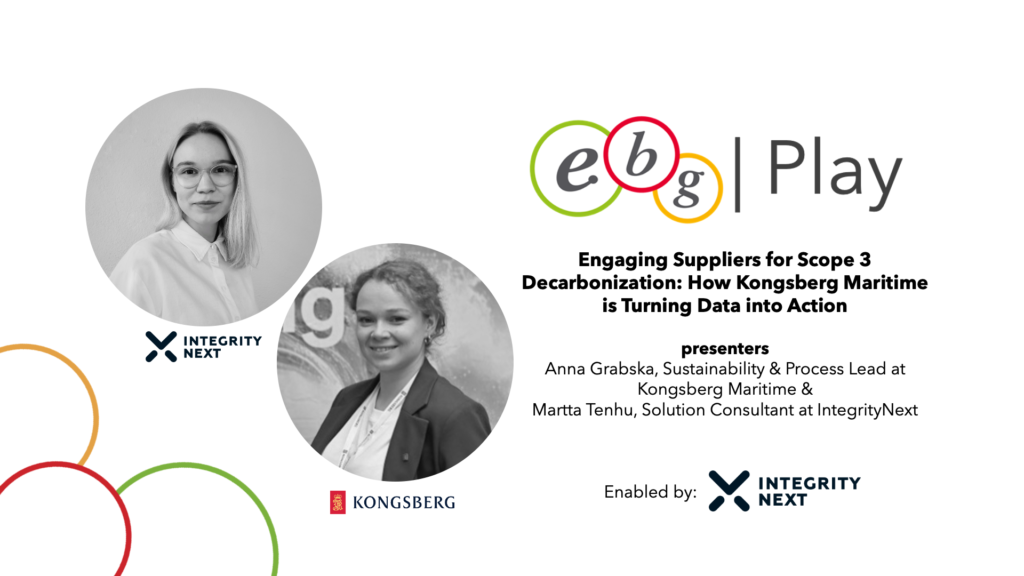
EBG | Play Webinar Recap | February 2026
“Supplier engagement does not start with emissions.”
That statement from Anna Grabska, Sustainability & Process Lead at Kongsberg Maritime, captured the central insight from last month’s webinar with IntegrityNext. In a session that drew strong engagement – including a 20-minute Q&A that still couldn’t cover all the questions sent in – Grabska shared how Kongsberg Maritime is operationalizing Scope 3 work across a global supplier base. Not as a compliance exercise, but as an extension of company values.
The Context: A Growing Momentum – But Execution Remains Hard
The webinar opened with Martta Tenhu from IntegrityNext setting the scene. Scope 3 emissions – those occurring in a company’s upstream and downstream supply chain – can account for up to 90% of a company’s total carbon footprint. Yet for most organizations, this is still the least visible and hardest to influence part of their emissions profile.
The Science Based Targets initiative (SBTi) recently announced that 10,000 companies worldwide now have validated science-based targets – representing over 40% of global market capitalization. That’s a near 30% increase from early 2025 alone. And among companies with validated targets, 91% report a positive overall impact on their business.
But setting a target and achieving it are two different things. BCG’s Carbon Action Report 2025 shows that companies actively engaging their suppliers are 9 times more likely to meet their Scope 3 goals. Yet only 1 in 3 are doing it.
Poll Results: Where Are Organizations Today?
Two live polls gave a snapshot of where the audience stands on Scope 3 data maturity and what barriers they face. The results revealed a clear pattern: most organizations are in transition – moving from estimation toward engagement – but supplier capacity emerged as the dominant challenge.
Watch the recording to see the full breakdown and hear Grabska and Tenhu’s reflections on what the results mean for organizations at different stages of the journey.
Kongsberg Maritime’s Journey: “Who Cares – Wins!”
Kongsberg Maritime’s approach to supplier engagement sits within a broader company philosophy: “Who cares – Wins!” The idea is simple: sustainability, compliance, health and safety, human rights – these are not separate boxes to tick. They are integrated into how the company operates and how it expects its suppliers to operate.
Kongsberg received SBTi validation in December 2023, with a target of 67% of suppliers by spend with their own science-based targets by 2027 – alongside a 25% reduction in upstream logistics emissions by 2030.
Grabska emphasized that Scope 3 work starts with embedding sustainability into all processes, not treating it as a bolt-on. “Engagement is not just one of the ticks on the list to do,” she said. “It’s an extension of our strategy.”
Importantly, Kongsberg does not require suppliers to be SBTi-validated. “Not every company is capable to do so,” Grabska explained. “But what we expect is for suppliers to follow the SBTi guideline – to be aligned and have science-based targets, even if they don’t go through formal verification.”
This pragmatic approach recognizes the reality that many suppliers – especially smaller ones – lack the resources for full SBTi validation. What matters is direction and commitment.
In the recording, Grabska shares Kongsberg’s current progress against their targets – including specific percentages and what’s still ahead.
Making It Work: Procurement as the Connective Tissue
One of the most practical insights from the session was how Kongsberg integrates sustainability into day-to-day procurement work. Category managers and strategic buyers review supplier sustainability profiles in every business meeting. The platform collects self-assessments on carbon footprint (GHG), human rights, health & safety, code of conduct, ISO certifications, REACH compliance, and more.
“We try to make sure that our procurement teams review IntegrityNext profiles with suppliers on every regular occasion,” Grabska said. “First of all to confirm the data is there and updated. But also to create a space where suppliers can ask questions – what do these requirements mean? How can they improve?”
This approach turns sustainability from a separate workstream into an integrated part of supplier relationships.
Supporting Supplier Capacity
Given that supplier capacity was the number one barrier identified in the poll, the Q&A explored how Kongsberg and IntegrityNext help suppliers who struggle with the requirements.
IntegrityNext runs webinars and provides guidance to help suppliers navigate the questionnaires. The platform already has 2 million active suppliers in its network across 190+ countries – meaning many suppliers will already have data on the platform from other customers.
Kongsberg’s approach is to guide suppliers step by step. “There are different companies with different maturity in these topics,” Grabska noted. “You have to make sure you are available in case of questions, that you have resources within your organization to guide suppliers.”
The company also recognizes high performers. For the second year running, Kongsberg presented a Sustainability Supplier of the Year award – a signal that engagement is about partnership and improvement, not just compliance.
The Data Journey: From Spend-Based to Primary
A recurring question in the Q&A: how do you move from spend-based estimates to better data?
Grabska was clear that this is a journey, not a switch. The key is prioritization – focusing first on high-spend suppliers and those with the largest emissions impact.
The practical message: you don’t need perfect data to start. Start with what you have, prioritize where the impact is greatest, and improve data quality over time.
The recording includes specific questions from participants on supplier numbers, SBTi percentages, and how Kongsberg handles different supplier categories – with candid answers from Grabska.
Key Takeaways
- Supplier engagement is about values, not just data.
Scope 3 work succeeds when it’s integrated into company strategy and supplier relationships – not treated as a separate compliance exercise. - Supplier capacity is the biggest barrier.
Organizations need to invest in helping suppliers understand and meet requirements, not just in collecting data. - Formal SBTi validation isn’t always necessary.
Requiring alignment with SBTi guidelines – rather than formal validation – can include more suppliers while still driving progress. - Make it part of regular business conversations.
Embedding sustainability reviews into routine supplier meetings keeps it visible and actionable. - Recognize progress.
Awards like Kongsberg’s “Sustainability Supplier of the Year” signal that this is a partnership, not a policing exercise.
Watch the Recording
The session generated more questions than we could cover – even with 20 minutes of Q&A. All who registered received the slides and recording.
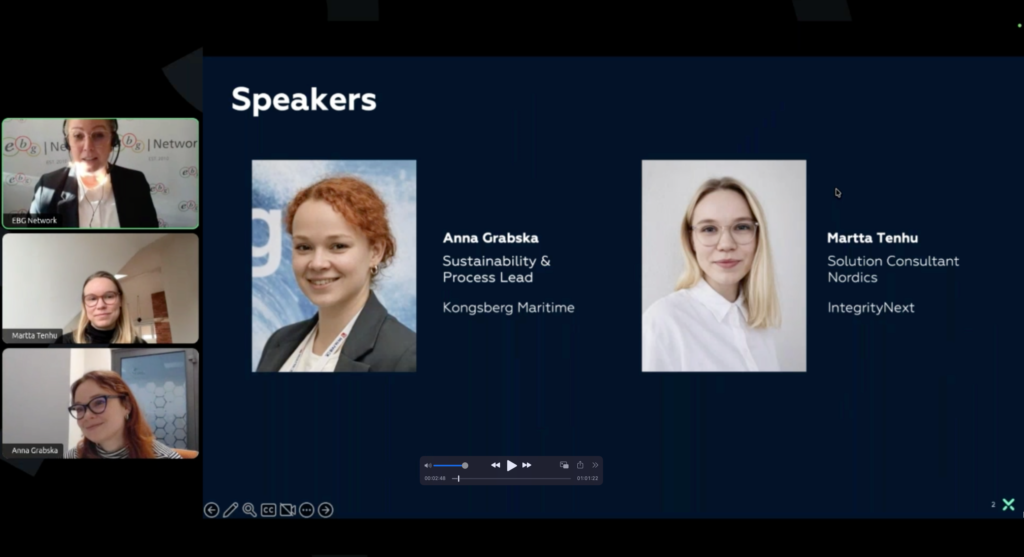
If you missed the live session: Watch on demand >>here
About Kongsberg Maritime
Kongsberg Maritime Maritime empower all maritime sectors—from offshore energy to fishing to cargo and naval—with cutting-edge technology and solutions to accelerate the energy transition. They have been at the forefront of innovation for over 200 years and support more than 30,000 vessels worldwide, ensuring safer, more secure, and sustainable operations.
About IntegrityNext
IntegrityNext, a global leader in supply chain sustainability software, stands at the forefront of corporate sustainability and compliance. Since 2016, businesses have trusted IntegrityNext to simplify ESG compliance, reduce risks, and address critical challenges like due diligence, decarbonization, and sustainability reporting. With over 500 customers and 2 million suppliers across 190 countries, IntegrityNext is transforming supply chains into engines of transparency and sustainable growth.
Connect with the Speakers
Anna Grabska – Sustainability & Process Lead, Kongsberg Maritime
LinkedIn
Martta Tenhu – Solution Consultant, IntegrityNext
LinkedIn
Continue the Conversation at EBG | Xperience
Want to dig deeper into supplier engagement, sustainability integration, and the practical challenges of operationalizing risk and sustainability? Join us at EBG | Xperience this spring in Stockholm and Malmö. Round table discussions, and the chance to exchange experiences with peers facing similar challenges – because developing businesses from a procurement perspective is never easy, and learning from each other makes it better. Not the least how to act as a leader when change is the only constant.
Learn more about EBG | Xperience >>