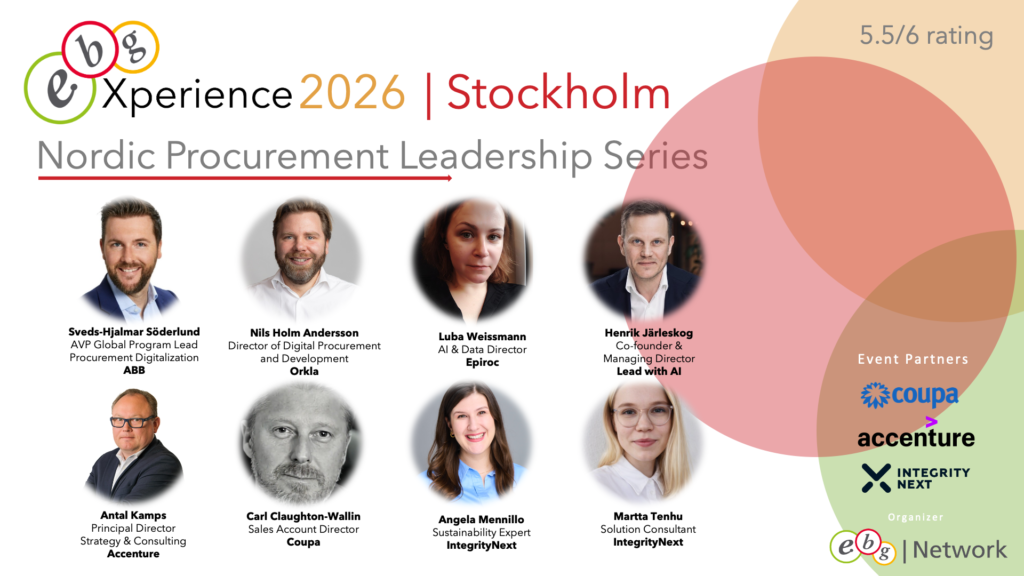
EBG | Xperience Stockholm 2026 brought thirty procurement leaders together at Scandic Grand Central for a focus day on AI, risk, leadership and transformation. The day’s red thread, set out at the opening: more responsibility, less control, faster change. Three expert organizations — Coupa, Accenture and IntegrityNext — opened the day with views from the broader market, followed by four longer sessions from Sveds-Hjalmar Söderlund (ABB), Nils Holm Andersson (Orkla Procurement), Luba Weissmann (Epiroc) and Henrik Järleskog (Lead with AI). Each took a piece of that environment and showed how their organization is designing for it.
What stood out, looking across the day’s sessions, was how directly the conversation has turned toward design. Not “more tools” or “more training.” Design — who decides, who approves, who is allowed to redesign their own workflow, what runs as process and what stays as judgment. Several operating models, several design moves, one shared underlying recognition: between a skilled team and the action that should follow, something has to be designed.
Three expert organizations sharing their views
The day opened with three expert organizations setting up the design conversation the four leaders would later go deeper on.
Coupa and Accenture held the first joint session: Anders Wannberg, Account Executive at Coupa, with Antal Kamps, Principal Director of Strategy & Consulting at Accenture. Their session, “From platform to practice — connecting procurement technology to how work actually gets done,” reframed the AI conversation in a direction the rest of the day would also land in. The right question, in their framing, isn’t “AI vs. Agentic AI” — it’s what outcome. Fragmented systems, siloed data and weak knowledge bases still limit what AI can deliver. Orchestration across tools, paired with user-centered experiences that drive real adoption, is where value gets unlocked. Their sketch of the new category manager — roughly 40% of time freed up by agent augmentation, with stronger compliance, auditability and cross-functional collaboration as the by-products — described what that looks like in practice.
IntegrityNext brought the sustainability and supplier-risk lens to the same design question. Angela Mennillo, Sustainability Expert, and Martta Tenhu, Solution Consultant, presented their session: “Making sustainability and supplier risk operational — from insight to everyday decisions.” Beyond tier one, most organizations are flying blind, their argument went. The data exists publicly; the infrastructure to use it doesn’t. Manual analysis works for fifty suppliers; it doesn’t for five thousand. And every regulation runs its own data-gathering process, creating contradictions that get noticed. The IntegrityNext network — 2.5 million active suppliers across more than 190 countries — turns the underlying infrastructure problem into an everyday workflow.
Both partner sessions did exactly what good opening sessions do: they gave the room shared vocabulary for the longer conversations that followed. Outcome over technology label. Foundations matter. Orchestration is the work. Make insight operational. Each phrase came back, in different words, in every session that followed.
Four leaders, four design moves
Sveds-Hjalmar Söderlund from ABB framed the design question most directly. Running procurement digitalization across a deeply decentralized, 110,000-person organization, his summary of what the work actually consists of was the line that hung in the room for the rest of the day:
“80% of our job is implementing. Change management can’t be underestimated.”
The technology is a small part. The governance — clear accountability between business and function, C-level buy-in, an actual structure for who decides what — is the work. ABB’s “as little as possible, as much as necessary” model is itself a design choice: scale through standards, not through control. Empowerment, in his telling, isn’t a culture slogan. It’s a governance design choice that shows up in everyday decisions.
Separating assessment from approval
Nils Holm Andersson at Orkla showed what that design looks like at the operational layer. Orkla’s risk management story is, fundamentally, about separating assessment from approval. The system can do the heavy lifting on assessment — covering 45,000 legal entities, integrating compliance, IT security, financial, sustainability and food safety risk into one auditable flow. The approval stays human and stays close to where the buying happens. That isn’t a constraint forced on the design. It is the design. AI can handle the process layer at scale; humans hold the decision where it matters. The structure determines what each can be trusted to do.
Is the pain real, or is the prize big
Luba Weissmann at Epiroc reframed the AI conversation away from the technology and back to the problem. AI, in her telling, isn’t a clean break from analytics — it’s the natural evolution of analytical maturity. Successful deployment is gated by the data foundation underneath. Her test for any AI initiative is severe and clarifying: is the pain real, or is the prize big? If neither, stop. The hub-and-spoke capability model she runs at Epiroc — central team owns the platforms and governance, business units own the solutions from day one — is itself a system answer to the empowerment question. Ownership at the edge. Standards at the center.
From overwhelmed to augmented
Henrik Järleskog from Lead with AI took the opposite entry point and arrived at a complementary place. The shift, he argued, starts with the individual. The leader who uses AI daily — really daily, as a thinking partner, not as an occasional novelty — sets a different gravity inside their team. The organization follows the leader’s behavior, not the leader’s mandate. Build one custom agent for one real task. See what it changes for you. Then bring it to the team. From overwhelmed to augmented, one agent at a time.
Two views of where transformation has to begin — with the system, or with the individual — and the room placed itself across both. There was no consensus on which path is right. There rarely is. What the four sessions had in common was the underlying recognition: something has to be designed.
A useful note from the pre-survey on the same question: when respondents were asked where meaningful AI adoption actually has to begin in a large organization, the leading answer wasn’t either side in isolation. It was visible pilots — proof of concept that creates the belief needed to scale. Henrik’s “build one agent” and Luba’s “is the pain real?” point to the same thing from opposite directions: a small, demonstrable, real-problem use case that the rest of the organization can see and reason from.
What the data is telling us
Four snippets from the pre-survey are worth pulling out, because each one points to a design opportunity.
The honest middle.
In 2025, 74% of Stockholm respondents described their digital maturity as “developing.” A year on, that figure rose to 78%. Zero percent called themselves “leading” in either year. The middle didn’t shrink. It got more honest. Some organizations that previously reached for “advanced” appear to have looked at the gap between aspiration and everyday reality and quietly stepped back into “developing.” That isn’t regression. It is the kind of accurate self-assessment that usually precedes the work that actually moves things. A more honest starting point is a better starting point.
The room is already moving.
Asked about urgency to fundamentally change how the team works, nearly half of respondents — 48% — said they are already moving, and that urgency has translated into concrete action. Another 23% reported high pressure and momentum. Combined, more than two thirds of the room is in active change mode rather than weighing whether change is needed. That is a different starting point than the procurement conversation had even a year ago.
Real time, already returned.
More than half the room — 53% — said they save one to three hours a week using AI tools today. Roughly a quarter save four to seven. The savings are real and distributed, and earlier than several published benchmarks suggest.
The ambition is set.
Forty-nine percent of the room expect AI to give them back eight or more hours a week within two years. That is an step from where today’s distribution sits, and it is exactly the right kind of stretch. The expectation will not arrive on its own — it arrives through design. The data didn’t ask the room to predict the future. It asked the room to set the bar. Stockholm set it high.
A note on what the room said about why action sometimes lags when an opportunity is in front of a team: it isn’t lack of skill, it isn’t fear of being wrong. It’s capacity and alignment. That insight is the design brief — and it is exactly the brief our four speakers showed how to answer.
What the room actually looked like
It is worth saying what this room actually looked like, because the texture matters and a survey aggregate can hide it.
Many of the organizations represented have grown through M&A — sometimes recently, sometimes serially. Mergers don’t just bring more spend; they bring more legacy, more operating models, more contracts to harmonize, and more stakeholders whose alignment is now part of any decision. The competing-demands texture in our survey is not abstract — it’s the lived consequence of a corporate landscape that has become more federated, faster, than its procurement function has been redesigned to handle. The integration challenge is now widely recognized, which means it can be designed for rather than worked around.
A second observation worth noting: the ERP fragmentation story that often gets told as the headline cause of procurement’s struggles was less universal in the room than the narrative suggests. Only a small minority were operating more than five ERPs. The technical mess is real for some — and for those organizations, consolidation is genuine work. For most, the more useful diagnosis is governance, not technology. Which is good news, because governance is something a procurement leader can actually move.
Most participants were, in practice, more centralized than decentralized — which gives the ABB model in particular something concrete to compare against. Sveds-Hjalmar’s “controlled decentralization” isn’t a destination most of the room is heading toward in full; it is a set of design principles most of the room can borrow from selectively.
When we asked the room who is using AI tools in their daily work, every hand went up — a contrast with similar rooms a year ago.
From the workshop tables
Two mapping exercises ran across the day. The first asked tables to place five procurement tasks — supplier evaluation, contract analysis, spend categorization, risk monitoring, negotiation prep — on a continuum from human-led to AI-led, both today and three years from now. The second mapped six common AI use cases against two dimensions: how clear the problem is, and how solid the data foundation underneath is.
The full table-by-table results will follow in the post-event report. A few patterns held across all of the tables, though, and they are worth naming here.
Augmentation, not replacement
Across all five tasks, very few dots reached pure “AI-led” territory — even at the three-year horizon, and even when consultants placed their dots based on the broader market. The room’s collective imagination of the next three years is one of human + AI, not AI alone. That has implications for how procurement skills need to evolve, where they don’t, and how new roles get described.
Some organizations are already there
On at least one table, today’s dots for spend categorization and analytics already sat on the human + AI side of the line, not on the human-led side. The shift is not theoretical for everyone. For some, it has already happened in pieces, and the conversation now is about how to extend that more deliberately.
The bravery to mark “Running on Hope.”
Mapping 2 had a quadrant for use cases with neither a clear problem nor a solid data foundation — a confessional zone, not a comfortable one. Some tables left it empty. Others marked it honestly. The bravery is itself the signal, and it tends to come from organizations already several steps into their design work.
A small footnote, with affection: at least one table went through the prescribed color legend and added their own — pink, yellow, navy, dark green. Engagement registered in palette. Consider it noted.
The behavioral lens: from capability to design
There is a useful frame from behavioral science that the day’s sessions, taken together, point to. People act when the system around them gives them somewhere to act into. Skill development on its own doesn’t produce skill deployment. The environment a skilled person operates in — the rules, the rewards, the friction, the defaults, the decision rights — is the larger lever.
This is the design opportunity in front of the function. The capability investment of the last several years has built a foundation. The forward move isn’t another round of training — it’s redesigning the system the trained people work inside. Decision rights. Approval thresholds. The explicit answer to who decides what. The data foundation. The cross-functional architecture.
That is governance work. It is the 80% Sveds-Hjalmar named. What Nils built into Orkla’s risk model. It is what Luba’s hub-and-spoke captures. What Henrik’s “leader-first” path begins to surface from the individual side. And it is what the partner sessions pointed to, each from their own angle: outcome over label, foundations underneath, orchestration across tools, insight made operational.
The good news is that this is design work — and design work is doable. Can be sequenced. Has principles. Is borrowable across organizations. Stockholm 2026 was, in essence, several organizations sharing their design notes with thirty other organizations who are now ready to use them.
Three things to take with us
1. Structure enables action — but only if people are designed into it. Sveds-Hjalmar’s line is the one to leave with. The governance model is the design. Change management is the work. Eighty percent of the work. Treat governance as a strategic asset, not as overhead.
2. Separating assessment from approval changes the whole system. Nils’ design. AI can own the process layer at scale. Approval remains human and remains close to where the work happens. That isn’t a limitation — it’s the architecture that lets both halves do what they’re best at.
3. The shift starts with the individual — and the problem. Luba’s test and Henrik’s path, taken together. Start with a real problem, not a feeling. Use it yourself first, daily, before mandating it for anyone else. The organization follows the leader’s behavior — not the leader’s slide.
The feedback survey finally asked – “Consider you get an extra 8 hours next week of freed up time – what would you do with it?” What do you think the answers were?
About EBG | Xperience2026
EBG | Xperience Stockholm 2026 took place at Scandic Grand Central, Stockholm, on 23 April 2026. Thirty procurement leaders, two opening partner sessions, four longer leader sessions, four mapping exercises. Thank you to our event partners — Coupa, Accenture, and IntegrityNext — and to all of our speakers: Anders Wannberg (Coupa), Antal Kamps (Accenture), Angela Mennillo and Martta Tenhu (IntegrityNext), Sveds-Hjalmar Söderlund (ABB), Nils Holm Andersson (Orkla), Luba Weissmann (Epiroc) and Henrik Järleskog (Lead with AI).
The pre-survey results referenced are based on 46 responses received as of 28 April 2026. Year-on-year comparisons draw on the EBG | Xperience 2025 post-report (Stockholm cohort). Full table-by-table results from the workshop mappings will follow in the post-event report.
Next stop: EBG Xperience Malmö was April 28th — and onward to CPO Outlook 2026, 14 +15 October 2026, where the Nordic CPO of the Year will be announced live. Nominations close 6 June. nordiccpoaward.com